
Concrete Joint Sealing Solutions & System Selection
Engineered polyurethane, self-leveling, and MS hybrid sealants protecting concrete slab joints against water seepage, subgrade settling, and heavy forklift wheel spalling.
Need Sizing Calculations or Project Quotation for Concrete Joints?
Our civil chemical engineers provide backer rod sizing, consumption estimates, and direct container pricing.
Structural Joint Mechanics, Failure Prevention & Sealant Sizing Guide
In-depth technical specification covering cyclic movement capacity, adhesive vs. cohesive failure mechanics, backup rod placement, and CAD cross-section sizing standards for commercial building envelopes and civil infrastructure.
🛡️ Engineering Joint Failure Analysis & Preventive Chemistry
Over 85% of architectural sealant failures stem from improper joint dimensioning or three-sided adhesion rather than chemical degradation. The table below details the physical mechanics and CHEMPU engineering countermeasures:
📐 Engineering Joint Movement Calculation Formula (ASTM C1472)
To calculate the minimum required design joint width ($W_{min}$) for concrete precast panels or curtain wall mullions:
Where: M = Sealant rated movement capability (e.g. 25% for PU-30/PU-40, 50% for SL-003); ΔL_thermal = Panel Length × Thermal Expansion Coefficient (α) × Temperature Differential (ΔT). For standard 6-meter concrete panels with ΔT = 50°C, design joint width should be at least 15 mm to 20 mm.
❓ Engineering Solutions & Joint Sealing FAQ
Q1: How should active moving concrete cracks be repaired compared to dormant cracks?
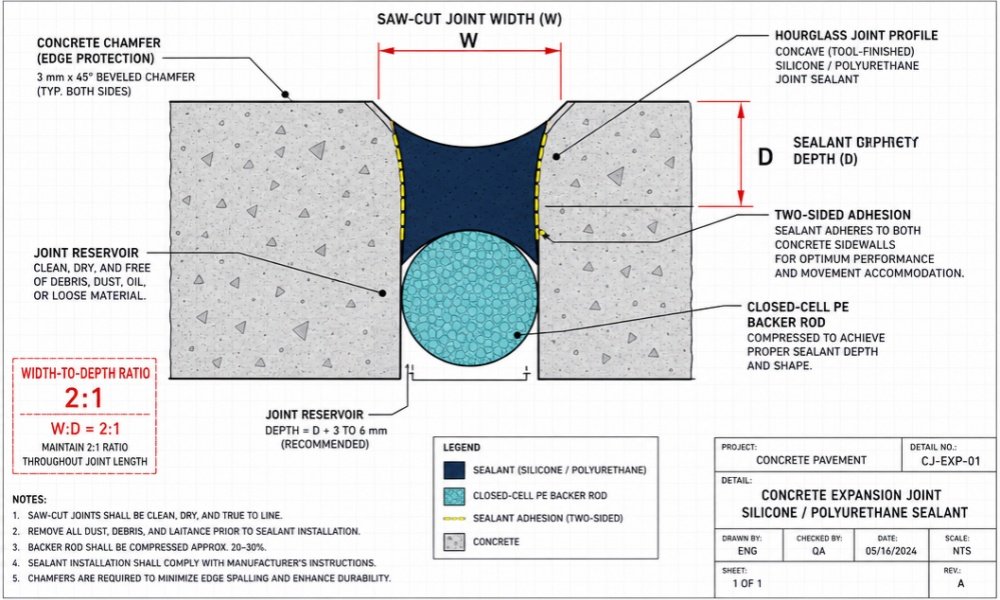
Dormant cracks with no dynamic movement should be pressure-injected with low-viscosity structural epoxy resins to restore compressive monolithic strength. Active moving cracks (subject to thermal breathing or foundation settlement) must be routed into a clean ‘U’ or ‘V’ groove (minimum 10 mm wide × 10 mm deep), fitted with backing foam, and sealed with elastomeric polyurethane sealant (CHEMPU PU-30 or SL-100) to allow cyclic movement without re-cracking.
Q2: What is the optimal lap joint sealing procedure for RV roof leak prevention?
Remove old, cracked butyl or silicone using plastic scrapers. Clean the EPDM, TPO, or fiberglass substrate with isopropyl alcohol. Apply CHEMPU MS-30RV modified silane sealant over all lap seams, screw heads, and roof vent flanges in a continuous 8–10 mm bead. MS-30RV flows into gaps under self-leveling action, cures without bubbling, and remains 100% UV stable without chalking or attracting road grime.
Q3: How soon after concrete placement should control joints be cut and sealed?
Saw cuts should be made as soon as the concrete has hardened sufficiently to resist ravelling (typically 4–12 hours after finishing). However, permanent elastomeric joint sealing with CHEMPU SL-100 or PU-30 should be performed after initial concrete shrinkage has stabilized (ideally 28–30 days) to prevent premature excessive joint widening and tensile tearing.
Q4: What certifications are provided for curtain wall structural glazing bidding?
CHEMPU supplies comprehensive project qualification packets including ASTM C1184 third-party laboratory test reports, 5,000-hour artificial xenon arc accelerated weathering reports, ASTM C794 peel adhesion test certificates, and factory structural bite dimensioning calculations verified by senior chemical engineers.
Request Concrete Joint Sealants Quotation
Fill out the form below. Our chemical sales engineers will reply within 24 hours.